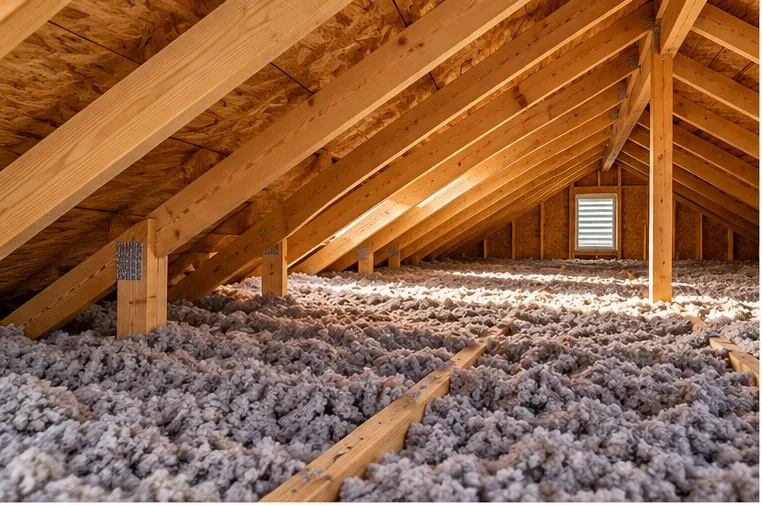
Cost per square foot
Cellulose is priced by the bag and bags are rated in R-square-feet, which is why cost scales with the R-value you are adding rather than with area alone. Adding R-49 over a bare ceiling costs roughly $0–$1 per square foot in material. Topping up an attic that already has R-19 costs about half that, because you are buying half the R.
That is the single biggest reason an average price per square foot is nearly useless here: what you pay depends on what is already up there, not on how big the attic is.
Cost by attic size
Materials only, adding R-49 over bare joists.
| Attic floor | Material cost | Installed |
|---|---|---|
| 800 sq ft | $392–$627 | $1,372–$2,744 |
| 1,200 sq ft | $588–$941 | $2,058–$4,116 |
| 1,600 sq ft | $784–$1,254 | $2,744–$5,488 |
| 2,000 sq ft | $980–$1,568 | $3,430–$6,860 |
Machine hire, and why small jobs cost more
Cellulose has to be blown. Most big-box stores lend the blower free with a minimum bag purchase — commonly around ten to twenty bags — and charge a day rate otherwise. That is a fixed cost spread over the job, so a 400 sq ft top-up carries the same machine day as a 2,000 sq ft attic.
Two practical consequences. Do the whole attic in one hire rather than a section at a time. And have a second person: one feeds the hopper while the other works the hose, and doing it alone roughly doubles the day.
Against blown fiberglass
Per square foot the two land close. Cellulose has the higher R-value per inch — R-3.5 against R-2.5 — so it hits a target in less depth, which matters when the joists are shallow or you are approaching the top of them. Fiberglass weighs less and does not absorb water.
Weight is the one to check on an older ceiling: cellulose at installed density is meaningfully heavier than fiberglass, and old lath-and-plaster was not designed with either in mind.
Settling, and paying for depth you keep
Settles roughly 10–20% over its life, so it is installed deeper than the final target. Not suitable where it will get repeatedly wet. Installers blow deeper than the final target to allow for it, and the coverage chart on the bag already accounts for settled density — so follow the bag count, not a depth you measured on day one.