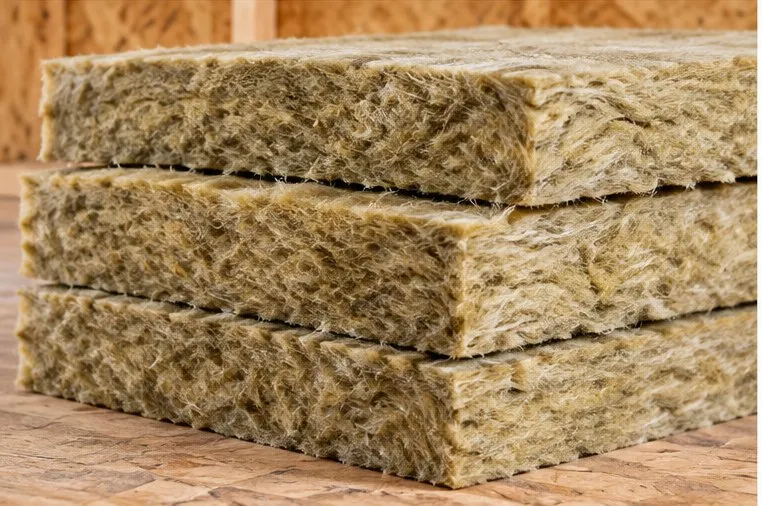
At a glance
Mineral Wool Insulation
- R-value per inch
- R-4.0
- Depth for R-30
- 7.5"
- Material only
- $0.84–$1.35per sq ft at R-30
- Installed
- $1.65–$3.30per sq ft at R-30
The most pleasant of the batt materials to work with. It is rigid enough to hold its shape, cuts cleanly with a serrated blade, and sheds far less airborne fiber than fiberglass. It is dense and heavy, which is tiring overhead.
Quantity and cost for your own square footage and climate zone.
Where to buy
R-value and depth
Mineral Wool Insulation delivers R-3.7 to R-4.2 per inch (R-4.0 typical). Because R-value accumulates with thickness, the depth you need depends entirely on your target — and your target depends on your climate zone. About 15 inches for R-60; R-30 batts are 7.25 inches.
Depth is the only thing that determines whether you actually hit your target R-value, which is why it is worth setting depth markers before you start rather than judging by eye.
How deep it has to go
Installed depth to reach each target R-value. Drawn to scale.
- R-30
- 7.5"
- R-38
- 9.5"
- R-49
- 12.5"
- R-60
- 15"
Nominal depths at the rated R-value per inch. Loose fill is installed deeper than its settled depth, and your own target depends on your climate zone — the calculator works both out for your attic.
Where it belongs
The most useful thing to know about any insulation material is not its R-value — it is which jobs it suits and which it quietly fails at.
Works well here
- Interior walls where sound transmission matters — it is meaningfully better than fiberglass
- Around chimneys, flues, and anywhere a non-combustible material is required
- Basement and crawl-space walls, where it tolerates dampness
- Cathedral ceilings and anywhere batts must hold their shape without sagging
Wrong choice here
- Standard attic floor retrofits on a budget — the performance gain does not justify the cost
- Large areas where blown material would be faster and cheaper
- Cavities with heavy obstructions, where any batt is the wrong format
Moisture
Mineral wool is hydrophobic — water beads and drains rather than soaking in — and it is vapor-permeable, so assemblies can dry. That combination makes it one of the few batt materials appropriate for below-grade walls and damp crawl spaces, where fiberglass and cellulose both cause problems.
Cost
Material alone, $0.84–$1.35 per sq ft at R-30. Professionally installed, $1.65–$3.30 per sq ft at R-30 — the difference is labor, equipment, and disposal.
Costs scale with R-value, not just floor area, so doubling your target roughly doubles the material cost. National ranges are wide because local labor rates and attic access vary enormously. See how we calculate these figures.
Installation
Friction-fit like fiberglass batts but easier, because the material holds its shape and does not need stapling in most cavities. Cut with a serrated insulation knife or a bread knife, slightly oversized. Wear a respirator — lower airborne fiber than fiberglass is not the same as none.
Advantages and limitations
Advantages
- Highest R-value per inch of the batt materials, so it hits targets in less depth
- Non-combustible, with a melting point above 2,000°F
- Water-repellent — it sheds liquid water rather than absorbing it
- Substantially better acoustic performance than fiberglass at the same thickness
- Rigid enough to friction-fit reliably and hold position for decades
Limitations
- Two to three times the cost of fiberglass for the same R-value
- Heavy, which makes overhead work tiring
- Not available as a blown loose-fill product for typical attic retrofits
- Less widely stocked, so you may need to order it
Lifespan
Does not settle, sag, decompose, or lose R-value. Realistically it lasts the life of the building. This is the strongest argument for the price premium in locations you will never open up again.
Mineral wool vs fiberglass
Mineral wool wins on fire resistance, sound, moisture tolerance, and R-value per inch. Fiberglass wins decisively on price. For an open attic floor where none of those advantages apply, fiberglass or cellulose is the rational choice.