At a glance
Cellulose Insulation
- R-value per inch
- R-3.5
- Depth for R-30
- 8.5"
- Material only
- $0.30–$0.48per sq ft at R-30
- Installed
- $1.05–$2.10per sq ft at R-30
Blowers are usually free with a minimum bag purchase. The work is dusty and awkward but not technically difficult. Two people makes it much faster — one feeding the hopper, one on the hose.
Quantity and cost for your own square footage and climate zone.
Where to buy
R-value and depth
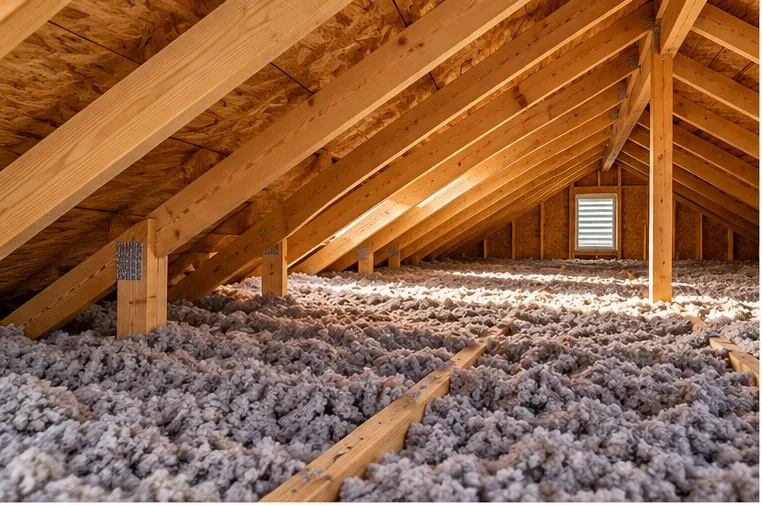
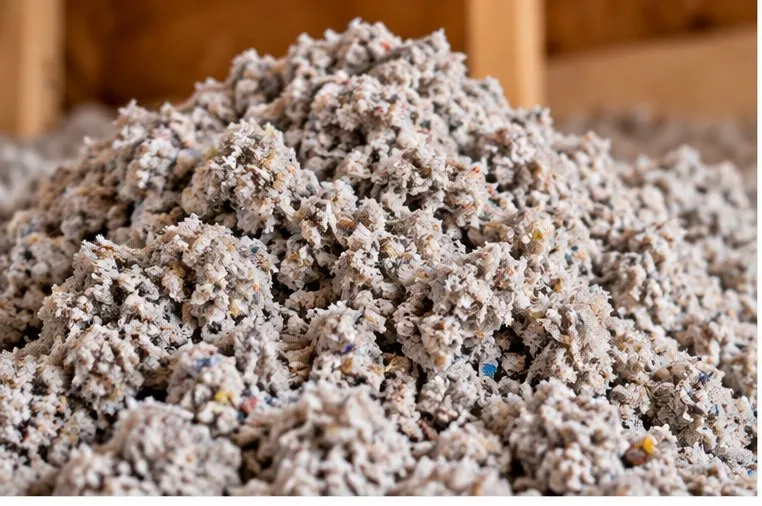
Cellulose Insulation delivers R-3.2 to R-3.8 per inch (R-3.5 typical). Because R-value accumulates with thickness, the depth you need depends entirely on your target — and your target depends on your climate zone. About 17 inches for R-60, 14 inches for R-49.
Depth is the only thing that determines whether you actually hit your target R-value, which is why it is worth setting depth markers before you start rather than judging by eye.
How deep it has to go
Installed depth to reach each target R-value. Drawn to scale.
- R-30
- 8.5"
- R-38
- 11"
- R-49
- 14"
- R-60
- 17"
Nominal depths at the rated R-value per inch. Loose fill is installed deeper than its settled depth, and your own target depends on your climate zone — the calculator works both out for your attic.
Where it belongs
The most useful thing to know about any insulation material is not its R-value — it is which jobs it suits and which it quietly fails at.
Works well here
- Attic floors with irregular framing, wiring, or lots of obstructions
- Topping up existing insulation without removing it
- Dense-packing closed wall cavities in older homes
- Situations where you want the material to conform around things rather than be cut to fit
Wrong choice here
- Anywhere that gets repeatedly wet — it holds water and loses R-value
- Crawl-space walls or below-grade applications
- Ventilated soffits without baffles installed first, since it blocks airflow
Moisture
Cellulose can absorb roughly 5–20% of its weight in water and dries slowly. A small roof leak that would barely affect fiberglass can compress and ruin a section of cellulose, and wet cellulose against drywall risks mold. Fix roof leaks before insulating, and add baffles so soffit ventilation keeps working.
Cost
Material alone, $0.30–$0.48 per sq ft at R-30. Professionally installed, $1.05–$2.10 per sq ft at R-30 — the difference is labor, equipment, and disposal.
Costs scale with R-value, not just floor area, so doubling your target roughly doubles the material cost. National ranges are wide because local labor rates and attic access vary enormously. See how we calculate these figures.
Installation
Blown in through a hose from a rented machine. Air seal and install rafter baffles first — once the insulation is down you cannot reach the gaps underneath. Set depth markers before starting; judging depth by eye across a whole attic is unreliable, and depth is the only thing determining whether you hit your R-value.
Advantages and limitations
Advantages
- Fills gaps and voids that batts leave open, so installed performance is closer to rated performance
- Roughly 80% recycled content, and the lowest embodied carbon of the common options
- Borate treatment resists fire, mold, and rodents
- Noticeably better at damping airborne sound than fiberglass
Limitations
- Settles 10–20% over its life, so it must be installed deeper than the final target
- Heavier than fiberglass — worth checking ceiling framing on older homes
- Dusty to install; a respirator is genuinely necessary, not optional
- Absorbs and holds moisture if the roof leaks
Lifespan
Effectively indefinite if it stays dry — 30+ years is normal. The failure mode is not decay but settling and water damage. Most attics benefit from a top-up after 20 years or so, as settled material sits below its original depth.
Cellulose vs fiberglass
Cellulose has a higher R-value per inch and seals gaps better; blown fiberglass is lighter, does not settle as much, and shrugs off moisture. For most attic retrofits cellulose gives better real-world performance for similar money.