Quick estimate
Encapsulation typically lands between $1,500–$15,000 for a whole crawl space, with a national average near $5,500. Floor insulation is a fraction of that. Which one you should buy is not decided by budget — it is decided by your climate and whether the space can be sealed at all.
Two different projects
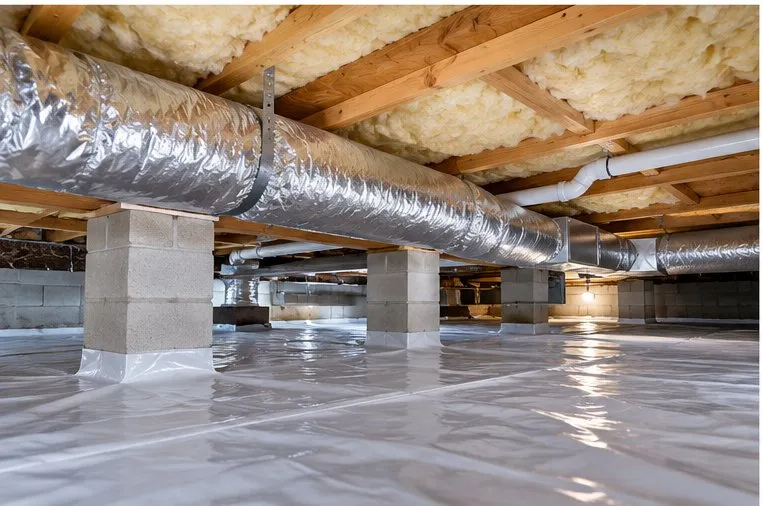
Vented floor insulation leaves the vents open and puts batts or board between the floor joists. Encapsulation seals the vents, lines the ground, insulates the perimeter walls and controls humidity mechanically.
Building science has moved decisively toward encapsulation, for a reason worth stating plainly: venting a crawl space in summer draws humid outdoor air onto surfaces below its dew point, so the ventilation meant to dry the space is what wets it. But vented floor insulation is still right in arid climates, and it is required where FEMA flood openings exist — sealing a crawl space that has to drain turns it into a basin.
Insulating the floor
- Materials only: $0.50–$1.25 per square foot.
- Installed: $1.50–$3.50 per square foot.
- Installed, with old insulation removed: $3.50–$4.00 per square foot.
Old batts in a crawl space very often fail — they sag out of contact with the floor, soak up damp and get nested in. Budget for removal unless you have looked and know otherwise.
Encapsulation
Wall insulation itself is $2.50–$5.00 per square foot of wall for rigid foam, or $1.50–$4.50 for closed-cell spray foam. That is rarely the largest line on the quote.
- Ground liner. 12 mil reinforced sheet, run up the walls and lapped, at $1.85–$3.00 per square foot installed. Code minimum is only 6 mil, but that is a vapour retarder, not something you can crawl on.
- Humidity control. Dedicated crawl space dehumidifier, $1,200–$3,000. IRC R408.3 requires a ground vapour retarder plus one humidity-control measure — a sealed crawl space with neither is a worse outcome than a vented one.
- Labour. 50–70% of the total. Working on your back in a 600 mm void is slow, and that is what you are paying for.
What is often left out of a quote
Insulating over a wet or mouldy crawl space makes the problem harder to find and more expensive to fix, and sealing a space containing an atmospherically-vented furnace or water heater can cause backdrafting and carbon monoxide. Standing water, active mould and combustion appliances are prerequisites, not upsells — get them resolved before any insulation goes in, and be suspicious of a quote that ignores them.
What changes the price
- Clearance. Under 24 inches adds 20–50%; a crawler cannot kneel.
- Debris and tear-out. Removing fallen insulation adds 20–40%.
- Access hatch size. Everything comes in and out through it.
- Ductwork. Ducts in the crawl space strongly favour sealing it, because the air they leak then stays inside your envelope.