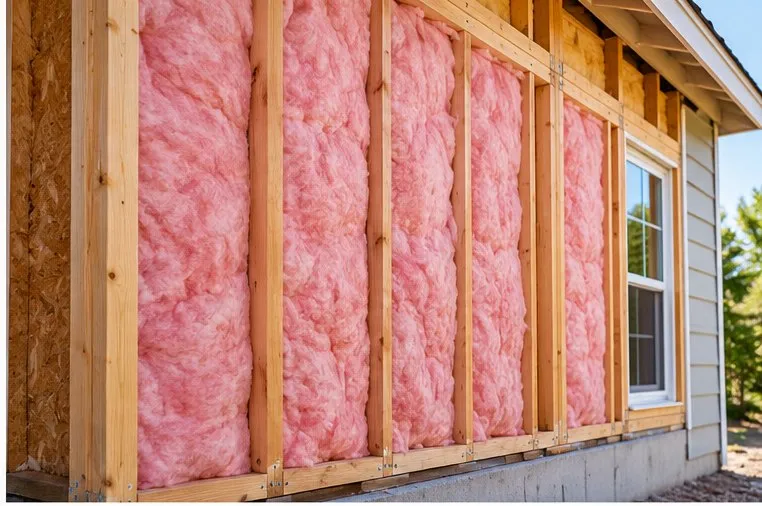
What the facing actually is
The kraft paper stapled to one side of a batt is a vapour retarder, not insulation. It slows water vapour moving through the assembly. Unfaced batts have no retarder at all, and the vapour control is done by something else — usually just the latex paint on your drywall, which is a perfectly legitimate Class III retarder.
Retarders are graded by permeance. Class I is nearly vapour-tight (polyethylene sheet), Class II is kraft facing, Class III is latex paint. Which classes are permittedis set by your climate zone, because the direction vapour travels changes with climate.
The rule for every zone
In cold climates vapour pushes outward from the heated inside, so the retarder belongs on the warm interior face. In hot humid climates it pushes inward from outside, so an interior retarder traps it in the wall — which is why kraft facing is not permitted in zones 1 and 2.
| Zone | Permitted | What to use |
|---|---|---|
| Zone 1Miami, Honolulu, Key West | Class III | Use UNFACED batts with standard latex paint on the drywall as your vapor retarder.Class I and Class II vapor retarders are not permitted here. Kraft-faced batts and polyethylene sheeting both trap moisture driving inward from outside — do not use them. |
| Zone 2Houston, Phoenix, Orlando, New Orleans | Class III | Use UNFACED batts with standard latex paint on the drywall as your vapor retarder.Class I and Class II vapor retarders are not permitted here. Kraft-faced batts and polyethylene sheeting both trap moisture driving inward from outside — do not use them. |
| Zone 3Atlanta, Dallas, Los Angeles, Charlotte | Class III, II | Kraft-faced batts (Class II) or unfaced batts with latex paint both work here.Do not install polyethylene sheeting — a Class I barrier is not permitted. |
| Zone 4Washington DC, Nashville, Portland, Kansas City | Class III, II | Kraft-faced batts (Class II) or unfaced batts with latex paint both work here.Do not install polyethylene sheeting. In the Marine 4 zone the rules differ — a Class I or II retarder is required there, so confirm which zone 4 you are in. |
| Zone 5Chicago, Denver, Boston, Salt Lake City | Class II, I | Kraft-faced batts (Class II) on the warm interior side are the normal choice. |
| Zone 6Minneapolis, Burlington, Helena | Class II, I | Kraft-faced batts (Class II) on the warm interior side are the normal choice. |
| Zone 7Duluth, Fargo, Fairbanks | Class II, I | Kraft-faced batts (Class II) on the warm interior side are the normal choice. |
The mistake that rots walls
If your walls already have foil-faced sheathing, rigid foam, or two inches or more of closed-cell foam on the outside, do not add an interior vapor barrier as well. A wall sealed on both faces cannot dry in either direction, which is how walls rot. Use unfaced insulation and let the interior side stay permeable.
This is worth checking before you buy, because it is easy to create by accident. Exterior foil-faced sheathing is already a Class I retarder. Add kraft-faced batts inside it and the wall is sealed on both faces — any water that gets in, from a leak or a bad detail, has nowhere to go in either direction.
Where each one goes
- Attic floors: unfaced, nearly always. Loose fill has no facing anyway, and you do not want a retarder under a ventilated attic.
- Exterior walls: by zone, per the table above.
- Interior partitions: unfaced. There is no vapour drive across a wall with the same conditions on both sides, and sound is usually the real goal.
- Basement and crawl space walls: neither — use foam board or closed-cell against the concrete, which is its own vapour control.
- Over existing insulation: unfaced only. A second facing mid-assembly is a vapour trap.
One practical note: the facing is also what you staple. Unfaced batts rely on friction fit or wire supports, which is one reason mineral wool — stiff enough to stay put unaided — is easier to work with unfaced than fiberglass is.