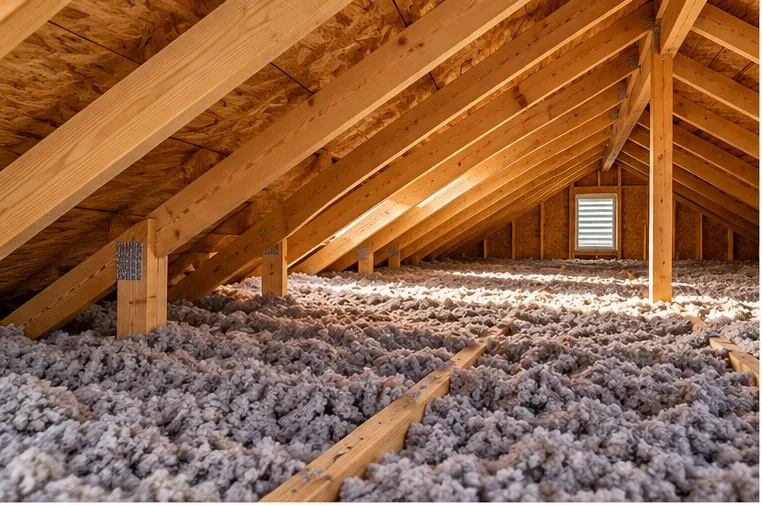
Working out what you need
What R-value do I need?
Start hereHow your climate zone sets the target, where code differs from guidance, and what the numbers mean.
Read moreHow much insulation do I need?
The full calculation worked through by hand — area, existing R-value, depth and bag count.
Read moreR-value chart
ReferenceEvery common material ranked by R-value per inch, with the depth each needs to hit a target.
Read more
Doing the work
How to insulate an attic
How-toThe nine steps in the order they have to happen, including the air sealing most guides skip.
Read moreDIY vs professional
Which jobs are genuinely DIY-able, which need equipment you cannot hire, and what the gap costs.
Read more
Choosing between materials
Fiberglass vs cellulose
The decision most attic projects come down to, on cost, R-value, settling and fire behaviour.
Read moreOpen-cell vs closed-cell spray foam
Two products sharing a name. They differ on R-value, vapour behaviour, cost and where each belongs.
Read moreSpray foam vs fiberglass
Foam costs around three times as much. The R-value gap is not what you are paying for — the air sealing is.
Read moreBatts vs blown-in
The most common attic decision. Settled by the shape of the space rather than by the numbers on the pack.
Read moreCellulose vs spray foam
Where foam earns its price, and where cellulose does the same job for a third of the money.
Read moreMineral wool vs fiberglass
Roughly double the price for a similar R-value. What that buys in fire, sound and moisture.
Read moreRigid foam vs spray foam
On a flat wall, board you fit yourself usually wins. Geometry is what rules it out.
Read moreFaced vs unfaced insulation
By zoneA climate rule, not a preference — kraft facing is correct in Minneapolis and a defect in Houston.
Read more
Working out what is wrong
People usually search the symptom long before the material. These start from what you have noticed and work back to the cause.
Signs you need more attic insulation
Seven signs worth taking seriously, and the one measurement that settles it either way.
Read moreIce dams
A heat problem, not a gutter problem. The three-part fix, and the expensive things that do not work.
Read moreCold floors above a crawl space
Why floor batts fail, why ducts down there change the answer, and the two fixes that work.
Read moreAttic condensation and mould
Frost on the sheathing is moist air from the house. Why insulating first makes it worse.
Read more
The order the work has to happen in
Most of what goes wrong on an insulation job is a sequencing mistake, not a material one. Each of these steps becomes impossible once the next one is done.
- Measure what is already there. Existing depth and material come straight off the target, and it is the single biggest factor in what you spend.
- Air seal. Gaps around flues, wiring and plumbing penetrations leak more than depth alone can fix, and they are unreachable once insulation is down.
- Fit baffles. They keep soffit vents clear. Blocked vents cause the moisture problems and ice dams the insulation was meant to prevent.
- Then add depth, to markers you stapled up first — loose fill looks even when it is not.