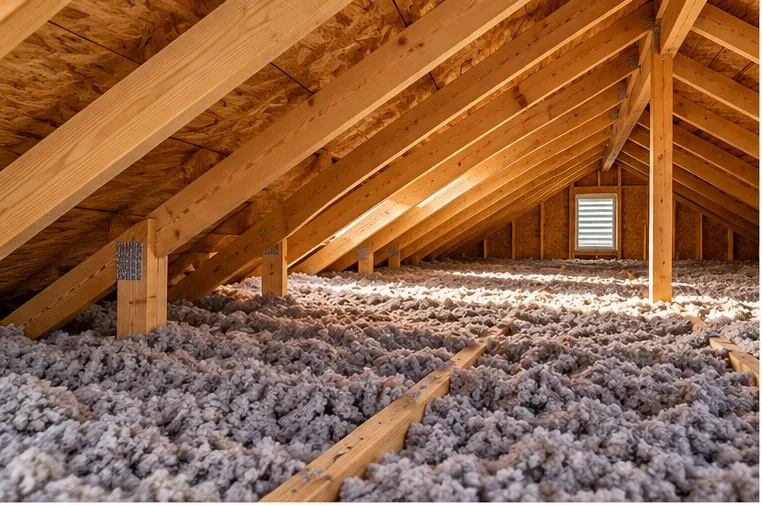
Side by side
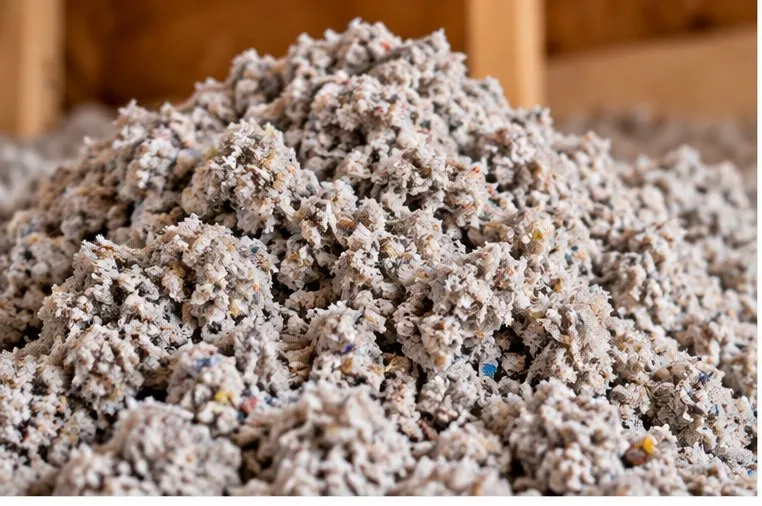 Cellulose
Blown cellulose
- R per inch
- R-3.5
- Depth for R-30
- 8.5"
- Installed cost
- $1.05–$2.10
- DIY
- Yes — hired blower
- Dense enough to resist air movement well
- Fills around obstructions completely
- Largely recycled content
- Can be removed and inspected later
Choose this when: Attic floors, dense-packed finished walls, most retrofits.
More on cellulose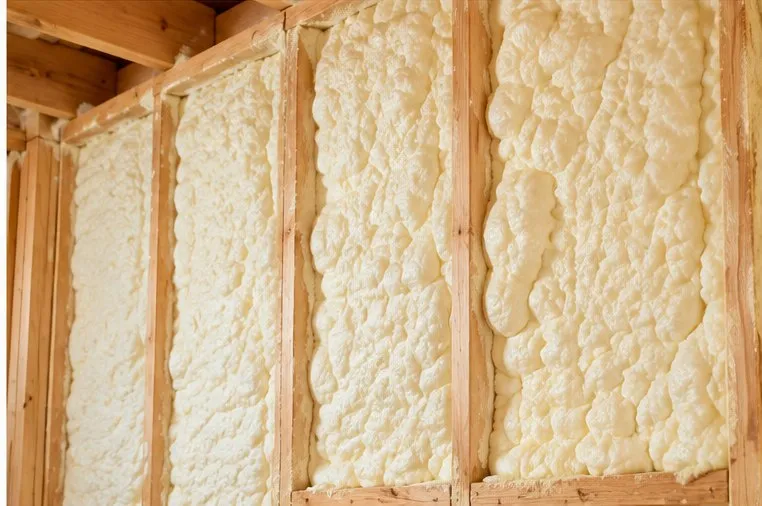 Spray foam
Open-cell spray foam
- R per inch
- R-3.6
- Depth for R-30
- 8.5"
- Installed cost
- $3.90–$6.60
- DIY
- No — rig and supplied air
- Air seals as it insulates, in one pass
- Expands into gaps nothing else reaches
- Stays put permanently — no settling
- Works in cavities with no floor to hold fill
Choose this when: Rim joists, cathedral ceilings, unvented roof assemblies.
More on spray foamThe cost gap
Installed, cellulose runs $1.05–$2.10 per square foot at R-30 against $3.90–$6.60 for open-cell foam. Over a whole attic that is a large difference, and for a vented attic floor it buys you very little: depth up there is nearly free, so the cheapest R-value per dollar wins and that is loose fill.
The economics flip where depth is constrained or the cavity cannot hold loose fill — a sloped ceiling, a rim joist, an unvented roof deck. There foam is not a premium version of cellulose; it is the only thing that works.
Which one can dry
This is the difference people underweight. Cellulose is hygroscopic — it takes on moisture and gives it back, and a small roof leak above it will show as a stain you can see. Open-cell foam is vapour-open too, which is why it is specified in assemblies that need to dry inward.
Closed-cell foam is the opposite: above about two inches it is its own vapour barrier, which is a feature in a crawl space and a hazard in a roof deck that also has an exterior barrier. A roof sealed on both faces cannot dry in either direction, and a leak in it stays hidden until the sheathing fails.
Cellulose also carries a borate treatment, which makes it fire-resistant and unattractive to insects and rodents — a genuine advantage in an attic over a long time.
Which to choose
- Vented attic floor: cellulose. Foam here is money with nothing to show for it.
- Finished wall retrofit: dense-pack cellulose — it is the main way an existing wall gets insulated at all.
- Rim joists: closed-cell foam. Cellulose cannot seal that geometry.
- Cathedral or unvented roof: foam, because the assembly has to be air-sealed to be safe.
- Budget is the constraint: cellulose, every time. Spend the difference on air sealing first.