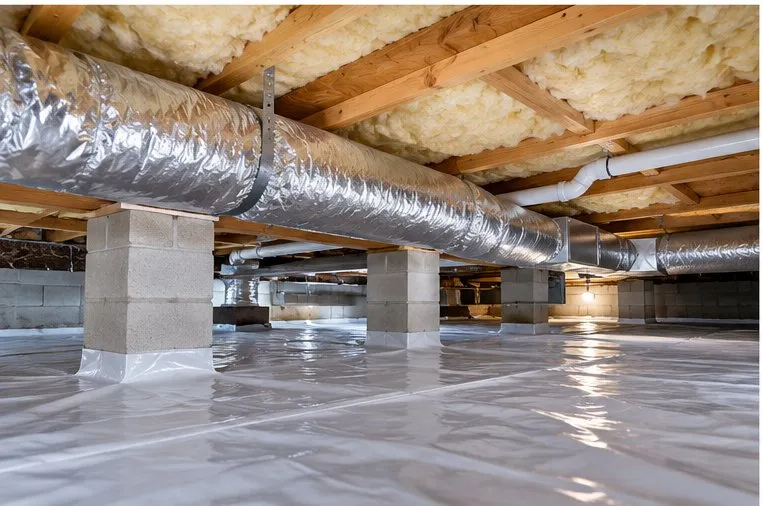
Rigid board is the DIY-feasible way to insulate crawl space walls, and the continuous layer that lets a 2x4 wall reach a code figure its cavity physically cannot. It is also the one insulation where picking the wrong product does active harm rather than simply underperforming.
The three types
| Board | R per inch | Below grade | Cost per sq ft, per inch |
|---|---|---|---|
| XPS rigid foam (pink or blue board) | R-5 | Yes | $0.70–$0.95 |
| EPS rigid foam (white beadboard) | R-4 | Yes | $0.50–$0.75 |
| Polyiso rigid foam (foil-faced) | R-5.8 | No | $0.75–$1.10 |
XPS rigid foam (pink or blue board). Explicitly rated for crawl space and below-grade use. Absorbs very little water, though long-term buried tests show it holds onto what it does absorb.
EPS rigid foam (white beadboard). Cheaper per board and dries far faster than XPS — a fifteen-year buried comparison found EPS drying back to under 1% moisture where XPS stayed near 16%. Needs more thickness for the same R-value.
Polyiso rigid foam (foil-faced). Do NOT use this below grade or against concrete. It wicks moisture out of the concrete and loses R-value doing it. The highest R per inch of the three, and the wrong choice here.
The below-grade rule
Polyiso has the highest R-value per inch of the three and is the wrong choice against concrete or earth. It wicks moisture out of the concrete and loses R-value doing it, so the board you chose for its performance ends up the worst performer in the wall. Use XPS or EPS below grade and save the polyiso for above-grade sheathing.
Between the two that are suitable, the trade-off is water. XPS absorbs very little but holds onto what it does absorb; EPS takes on more and dries far faster — a fifteen-year buried comparison found EPS back under 1% moisture where XPS stayed near 16%. EPS needs more thickness for the same R-value and costs less per board, so the two often land in the same place on price for the same performance.
Where it belongs
- Crawl space walls. The standard encapsulation detail, and genuinely DIY-able.
- Rim joists. Cut-and-cobble board sealed at the edges, where batts never seal properly.
- Continuous exterior sheathing. The "+5ci" half of a code path like 20+5ci — an unbroken layer outside the studs is what defeats thermal bridging, which is why it is worth more per R than the same R added inside a cavity.
- Under slabs, where EPS and XPS are both rated for the load.
The ignition barrier you cannot skip
Foam left exposed needs a covering. IRC R316.5.4 — ignition barrier, not a full thermal barrier. Applies where the crawl space is entered only for repairs or maintenance. Any of these satisfy it:
- 1½ in mineral fiber insulation
- ¼ in wood structural panel
- ⅜ in particleboard
- ¼ in hardboard
- ⅜ in gypsum board
- 0.016 in corrosion-resistant steel
- ¼ in fiber-cement panel
A garage is different and stricter — the crawl space relaxation does not reach one, and exposed foam there is a straightforward code violation.
Cost
Board is priced per square foot per inch of thickness, which makes comparison easy: at $0.50–$0.75 for EPS and $0.75–$1.10 for polyiso, the cheaper board is rarely cheaper once you buy the extra thickness it needs. Installed on crawl walls by a contractor, reckon on the rate in the crawl space cost guide.